By Grace Lawrence
This section begins with President Bill Clinton’s speech regarding the Good Friday Agreement in Ireland, given November 1995. In the speech linked above, Clinton states that “America’s connections to this place go back a long, long time” (Youtube). Clinton then goes on to explain that his “privilege to be the President” has allowed him to meet people from many different groups and political parties, and thus has allowed him to draw the conclusion that “The deep divisions, the most important ones, are those between the peacemakers and the enemies of peace” (Youtube). This is essentially diminishing the past and ongoing struggle that so many in Northern Ireland have experienced. This statement is also not entirely clear; one could interpret “enemies of the peace” as members of the IRA or also as Unionist. Clinton’s speech can also be interpreted as a way to gain popularity all over the world, especially amongst Irish Americans, who felt a connection to the Troubles. Compared to past presidents, however, Clinton did more to assist in the Irish Peace Process than any past president.
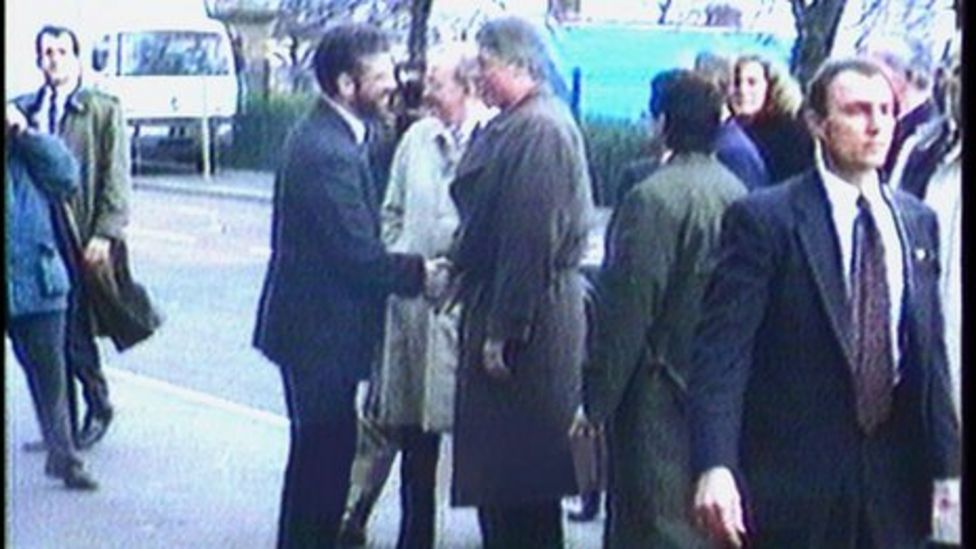
America also played a role as a provider for the IRA. In the previous section of Say Nothing, the reader sees Brendan Hughes in New York City meeting “with representatives from the Irish Northern Aid Committee, or ‘NORAID,’ a fundraising group” and he gets into an argument with “an opinionated Irish American benefactor” about the IRA’s war strategies (Keefe 210). Since there is such a large population of Irish-Americans, they feel almost connected to the IRA’s cause, resulting in this arrogance and ignorance. This is seen in Clinton’s speech at the beginning of Chapter 20, when he talks about how Derry “‘is a very different place from what a visitor like [himself] would have seen just a year and a half ago”’ (223). While he acknowledges the fact that he is just a visitor, he almost seems to disregard the efforts and lives lost by so many Irish people. However, the Clintons have continued their efforts in Northern Ireland and in 2013 Susan Brophy stated that “Former US President Bill Clinton considers his work in Northern Ireland to be probably his “top foreign policy achievement” (Coulter 2013). Compared to past presidents such as Nixon, who didn’t interfere with the Troubles in Northern Ireland, Clinton “developed an interest in Northern Ireland during his time at Oxford University” and eventually “his administration made the controversial decision to grant Sinn Fein President Gerry Adams a visa to enter the USA in 1994” (Coulter 2013). In fact, “prior to the presidency of Jimmy Carter, executive branch involvement in the province’s affairs had been limited to a few brief hints and vague expressions of hope” (Dumbrell 116). What this shows is that although Clinton’s speech gives off a sense of superiority, he put in more effort to support Northern Ireland than any of the past presidents in the US.

Although within the speech it seems as though America was heavily involved in the Troubles, this was not always the case. In fact, many Irish-Americans were in a sense misinformed about what was actually occurring in Ireland during the Troubles. In the journal article The United States and the Northern Irish Conflict 1969-94: From Indifference to Intervention, the author looks at how America slowly inserted itself into the troubles. The article states that “Over the years of the recent troubles, Irish-Americans have frequently been portrayed as atavistic nationalists, whose ‘emotions and loyalties’ (in the words of Margaret Thatcher) ‘are manipulated by Irish Republican extremists.”’ (Dumbrell 108). In addition, “For James Prior, [the Northern Irish Secretary of State at the time]…the most difficult people are those congressmen and senators, like Senator Edward Kennedy, with large numbers of Irish constituents who still harbour views which originate from the potato famine of the 1840s and the ghastly oppression to which the British subjected them” (108). Take notice, however, that these are British politicians that are stating this, so there is still some bias within their statements. It is also pointed out in this same article that “London’s constant evocation of this stereotype has contained an element of scapegoating” (108) and that “the modern version of the ‘tinsel patriot’ stereotype also misrepresents the complexity of Irish America” (109). This goes to show that Britain was able to skew information outside of their own land and in America.
References:
Coulter, P. (2013, January 18). Christmas with the Clintons: When Bill and Hillary came to Belfast in 1995. Retrieved November 17, 2020, from https://www.bbc.com/news/uk-northern-ireland-21029865
Dumbrell, John. “The United States and the Northern Irish Conflict 1969-94: From Indifference to Intervention.” Irish Studies in International Affairs, vol. 6, 1995, pp. 107–125. JSTOR, http://www.jstor.org/stable/30001841. Accessed 16 Nov. 2020.
Keefe, Patrick Radden. Say Nothing: A True Story of Murder and Memory in Northern Ireland. Doubleday, 2019, pp. 223-348.
Sheridan, J. (2017, February 20). A spotlight on US role in early years of Troubles. Retrieved December 15, 2020, from https://www.irishtimes.com/culture/books/a-spotlight-on-us-role-in-early-years-of-troubles-1.2982136
 A Reader's Guide to Say Nothing