Written By Devan Bugbee
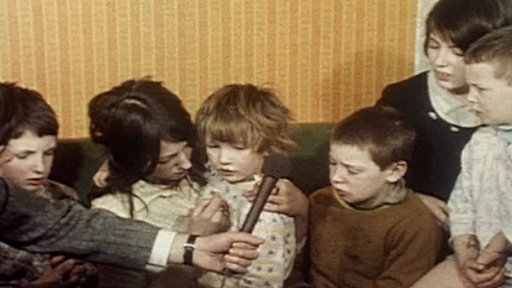
After a month since the kidnapping of Jean McConville, BBC interviewed her 10 children who were present during the abduction. The children were understandably terrified at what they had just experienced. The interviewer, Graham Leach, was merciless as he asked the kids, some toddlers, about their mother that that had just been taken from them, and attempted to pry out what they knew. This gave the effect that the Irish were unable to manage themselves, and BBC reinforced this concept using visuals, language, and sound, exploitation, and manipulation to ultimately convey sympathy and justify paternalism over Ireland.
The sight of those kids was meant to leave the viewer appalled. In the BBC clip, six of the McConville children are toppling over one another on their couch with Agnes sitting on an arm of the furniture with her younger brother, Tucker, on her lap, another younger brother, Billy, needing to be in the lap of Helen, the oldest, with a kid squashed in between (his name is Jim); and then there was Michael who was being almost hidden behind Leach (BBC, 0:00). This visually was supposed to show that they lived a poorer lifestyle and that these Irish children did not live in adequate conditions. They were visibly in a terrible situation, and need of help.
The interview also portrayed them as less educated with how they spoke. These children had Irish accents that can be heard throughout the session, which often made it hard to understand what the kids were saying. This is best represented 47 seconds into the interview when Agnes says her grandmother is “Blaint,” and Leach almost correcting her by repeating “she’s blind” (BBC, 0:47-0:51). Often, even if their accent does not prevent them from communicating, a loud sound going on in the background throughout the interview does. This sounds like a washer or dryer, and once again reinforces this idea that they are this poor Irish family, unable to prepare their home for an interview.
The dialogue has very clear instances of BBC exploiting these kids and their current situation. One of the first noticeable things is that there is no adult figure present in the household. Leach starts the interview by asking Agnes to recall the events (BBC, 0:01). Agnes struggles to recollect the event of her mother being taken, which is exactly to be expected from someone her age (BBC, 0:03-0:31). Leach’s demeanor indicates that he is less interested in caring for the livelihood of these kids than instead using them to be propaganda tools against the Irish Catholics. This is not the only time in the interview that Leach purposely asked questions that seemed out of touch, either. He asked them how they were getting by, and when Helen says that she has a source of income, he asks if it’s enough to get by. When she says yes, he inserts “does it manage to feed all the family? Because you’ve got a large family” (BBC, 1:03-1:14). His questions are one after another, and he seems as though he is trying to one-up or mock the kids, not comfort or even show that he has genuine intentions there as a journalist trying to get help for these kids. Instead, it seems like he is trying to make them look pitiful, and moreover, look like the British need to intervene to save the Irish from their destructive tendencies. In such, Leach sought to affirm a boundary between Irish Catholics and the British populous, and characterize it as one necessitating paternalistic intervention.
Works Cited
“Agnes McConville: ‘We don’t know why they took our mother”. BBC.Accessed December 14, 2020.
 A Reader's Guide to Say Nothing