Written by Emily Goldstein
With the increasing tensions and violence occurring within Northern Ireland during the beginning of 1970s the British Government resorted to sending their military forces to quell the clashes between the Catholics and Protestants and nationalist republicans in the region. As a result of this, General Frank Kitson of the British Army was sent to Northern Ireland because of his previous successes in fighting insurgent groups, which to the British, the IRA was. Kitson believed that the most important aspect to counter-insurgency operations was having sound, strong intelligence. Kitson was operating under the Special Powers Act of 1922. This Act, also known as the Civil Authorities Act of 1922, was created, “to empower certain authorities of the Government of Northern Ireland to take steps for preserving the peace and maintaining order in Northern Ireland, and for purposes connected therewith” (McKenna). What this did, was grant, “the civil authority… power, in respect of persons, matters and things within the jurisdiction of the Government of Northern Ireland, to take all such steps and issue all such orders as may be necessary for preserving the peace and maintaining order” (McKenna). Meaning, that under this Act, those acting in favor of the British Parliament can take all steps they deem necessary to maintain the peace within the region. This meant that Kitson and his command were within legal right to raid the homes of hundreds of Catholic Republicans and place them into internment centers. These raids, along with the use of the “enhanced interrogation” at the internment centers were just some of the methods used to gather intelligence deemed vital in the fight against the IRA.
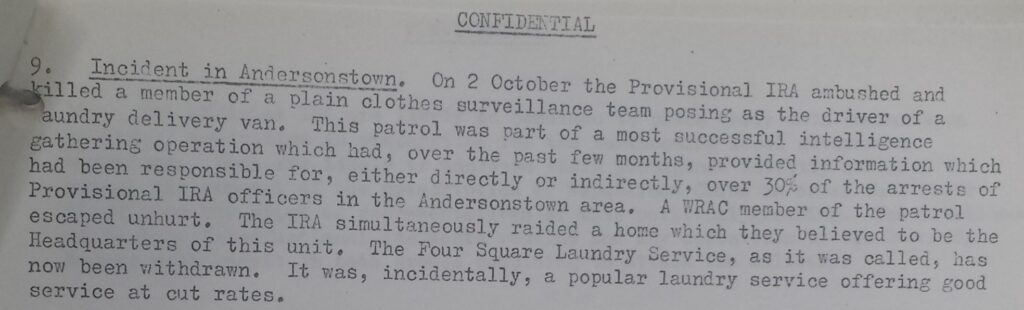
As Keefe notes, the intelligence gathering campaign was aggressively implemented by the British, leading to the formation of the Military Reconnaissance Force. This clandestine group was established to carry out operations both acting off the intelligence already gathered as well as gathering more. As the goal of this special operations group was clandestine operations, the members blended into the Northern Ireland atmosphere as average everyday citizens. This, in association with the counter-gang initiative that turned IRA members into informants for the British known as “Freds,” created an environment of uncertainty among both factions, however it was felt more heavily by the IRA and Catholic population. The increased uncertainty was due to the success of Kitson’s attempt to create informants at relatively high levels of leadership within the IRA, as Keefe mentions (124-125). However, it was also due to the differing levels of skills, and outside support available. Kitson had the backing of the British military to fund his operations and provide the highly-trained individuals needed to carry-out the operations. This is in stark contrast to what the IRA had at their disposal. This is because while the IRA was fairly organized and trained, they still lacked a skill set possessed by those trained by the British, and in addition lacked a government backing of their own operations, leaving them with limited funds to carry-out their own operations.
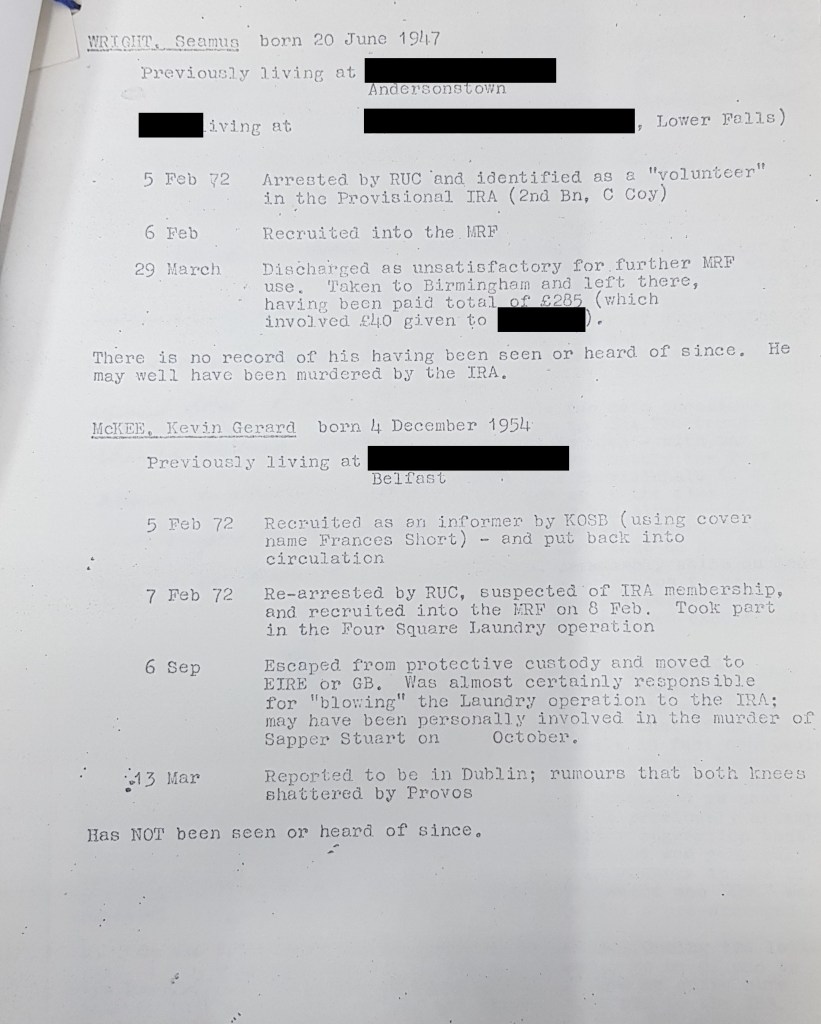
The Catholic, non-IRA membership, proportion of Northern Ireland also experienced an increase in uncertainty due to the presence of the MRF and their offensive operations. Under the guise of “offense” the MRF carried-out operations at car checkpoints, and bus terminals that lead to multiple civilian deaths and injuries, including the death of Patrick McVeigh (Melaugh). Following the laundry van operation Keefe mentions (130), that led to the death of the undercover British soldier, the unit was believed to be shut down. It is rumored to have shut down in 1973, but it is not confirmed as records relating to the MRF were destroyed (Melaugh). Since the shut down of the unit, BBC released a television program with interviews of former MRF members in 2013 (“Panorama MRF”). Following the airing of this documentary, the Police Service of Northern Ireland opened an investigation into incidents that led to the injury of seventeen civilians and two deaths, including the death of Patrick McVeigh (“Military Reaction Force”). However, since the airing of the episode, the Panorama has lost all evidence and files on the operations and those involved (“BBC’s Panorama”). The investigation into these incidents demonstrates a newly developing level of accountability not previously seen during the operation of the MRF in the 1970s. Choosing to open an investigation into these actions that occurred over thirty years ago not only shows the lasting effects conflict can have on a society, but holds those who operated within blurred legality boundary lines accountable. However, with the British media “losing” the evidence in these alleged crimes, shortly after the investigation opened, it proves that there is something implicating in those files that the British do not want to expose. This creates a new issue of accountability for actions committed during warfare, as well as protecting the classified nature of the operations and those involved, something that was overlooked and ignored prior to the BBC program airing and subsequent “losing” of files.
Works Cited
“BBC’s Panorama ‘Lost Files’ on British Army Unit in North.” The Irish Times , 3 July 2014, http://www.irishtimes.com/news/crime-and-law/bbc-s-panorama-lost-files-on-british-army-unit-in-north-1.1853893.
Great Britain, Parliament , and Fionnuala McKenna. Civil Authorities (Special Powers) Act (Northern Ireland), 1922, 1922. CAIN, cain.ulster.ac.uk/hmso/spa1922.htm.
Keefe, Patrick Radden. Say Nothing: A True Story of Murder and Memory in Northern Ireland. New York, NY. Anchor Books. 2019.
Melaugh , Martin, et al. “Abstracts on Organisations – M.” CAIN, cain.ulster.ac.uk/othelem/organ/morgan.htm#mrf.
Melaugh, Martin. “A Chronology of the Conflict.” CAIN, cain.ulster.ac.uk/othelem/chron/ch72.htm.
“Military Reaction Force: Breakthrough in PSNI Investigation.” BBC, 2 Dec. 2015, http://www.bbc.com/news/uk-northern-ireland-34980462.
“Panorama MRF Programme: Soldiers ‘Admitted No Crimes.” BBC, 13 May 2014, http://www.bbc.com/news/uk-northern-ireland-27389349.
 A Reader's Guide to Say Nothing