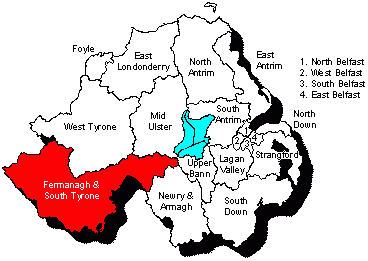
On April 9, 1981, Bobby Sands was elected to serve as a Member of Parliament. Earlier in March, the representative for the district of Fermanagh/South Tyrone died, and someone needed to take his place for the by-election. Sinn Fein put Bobby Sands’ name in as a candidate and all other candidates withdrew except for one, the Unionist candidate named Harold West. This directly pitted the Republicans and Unionists against each other, and many awaited the results to see how the constituency would vote. The people of Fermanagh/South Tyrone clearly cared about the outcome of the by-election, as voter turnout was 86.9%; Sands received 30,492 votes while Harold West received 29,046 votes (CAIN Archive).
What made Bobby Sands’ election to Parliament so noteworthy is that he was a member of the Irish Republican Army (IRA), in prison, and on hunger strike at the time of his election. Sands’ election was met with polarizing responses. For republicans, members of the IRA, and many Catholics, it constituted a cause of celebration. Danny Morrison, one of Sands’ campaign organizers, said: “This has finally proved through the ballot box how deep the support is for the republican prisoners. The people have spoken on behalf of the Irish nation” (Borders 1981). In the cities and towns of Belfast, Cookstown, and Lurgan, people held parades and celebrations when they heard the news. In contrast, prominent British political figures were less than thrilled. At a peace conference in the Middle East, the British Prime Minister Margaret Thatcher stated in response to a question of whether she would meet with Sands or consider giving him some sort of status besides prisoner said: “There can be no question of political status for someone who is serving a sentence for crime. Crime is crime is crime: it is not political, it is a crime, and there can be no question of granting political status” (Margaret Thatcher Foundation). This type of thinking from the highest ranking member of the British government meant that he was not seen as an equal or even part of the government but rather propaganda for the IRA. Bobby Sands never set foot in Westminster, dying on on May 5, 1981, just under a month after being elected.
Sands’ election represented an important moment for the IRA and other republicans. It allowed them to see how far the British government would go in their categorization of IRA prisoners. Once internment ended in 1975, members of the IRA who were arrested were no longer considered political prisoners. This delegitimized the cause of the IRA, and members felt that this attacked their sense of identity and ability to make statements (Keefe 201). Since Bobby Sands was on hunger strike when elected, they wondered if the British government would let him die now that he was technically one of them (Keefe 213). These actions and beliefs signaled a change in how the IRA approached their strategy of accomplishing their goal of expelling the British and uniting Ireland. Instead of using violence and armed tactics, they began to emphasize the importance of voting and participation within the system. This became known as the “ballot box and armalite” strategy.
Republicans had long abstained from voting as a form of protest, so this signified a shift in the overall psyche of this demographic (Keefe 214). For a population that had been disenfranchised for so long, it is interesting to consider how this became a possibility after not trusting the system. It shows the power of the IRA leadership in convincing their followers to vote. Although the IRA often consisted of people considered radical that felt disillusioned from the idea of working within the system, this shift in strategy made sense. If the leadership of the IRA wanted to maintain any sort of popularity and support from other countries, they had to make it seem like the IRA was a legitimate force and not a terrorist group. By employing the “ballot box and armalite” strategy, they could placate the more radical people while also gaining support from people who were less radical. It was a win from both sides and kept them relevant. Another aspect of this strategy was that Gerry Adams came to power and built a name for himself through his work of promoting the “ballot box and armalite” strategy. Adams would come to play a major role in Northern Irish politics in decades to come, so tracing his power back to this particular moment is important to understanding his role.

The election of Bobby Sands to Parliament and the shift in strategy of the IRA directly sent a message to the British government. The fact that someone they considered a criminal, Bobby Sands, could be elected to a prestigious position in Parliament meant that they had to reflect on their actions and ability to control the situation in Northern Ireland. If the majority of people in Northern Ireland democratically elected a candidate backed by the IRA, the British government had to consider that the IRA’s beliefs were more popular than they previously thought, which was the whole point of nominating Bobby Sands as a candidate. The British government became aware of the IRA leadership’s new strategy and felt threatened by it. On July 2, 1981, Parliament passed the Representation of the People Act which stated that anyone in prison for over a year could not hold office as a member of Parliament. This essentially barred any hunger striker from running for office, meaning that the British government feared the growing power and success of the IRA in the political arena. While Bobby Sands’ election is just one of many instances of IRA resistance and subversion of the British government and system, it impacted the course of the IRA, Gerry Adams’ career, and the focus of Parliament, demonstrating its lasting importance.
Works Cited
Borders, William. 1981. “Jailed I.R.A. Member Wins Commons Seat.” The New York Times. April 11. https://www.nytimes.com/1981/04/11/world/jailed-ira-member-wins-commons-seat.html
CAIN Archive. “The Hunger Strike of 1981 – A Chronology of Events.” https://cain.ulster.ac.uk/events/hstrike/chronology.htm
Keefe, Patrick Radden. 2019. Say Nothing: A True Story of Murder and Memory in Northern Ireland. New York: Anchor Books.
Margaret Thatcher Foundation. “Press Conference ending visit to Saudi Arabia (IRA hunger strikes).” https://www.margaretthatcher.org/document/104501
 A Reader's Guide to Say Nothing