Written By Devan Bugbee
Ian Paisley was an Irish Unionist famed for his pro-British stances. During The Troubles, Paisley grew to become the figurehead of Conservatism in Northern Ireland. If people in the IRA like Brendan Hughes or Gerry Adams were the faces of Irish Nationalism, then it is only fitting due to his polar opposite stances that Paisley would surely be the face of British Nationalism. He co-founded his own church in 1961 and called it “The Martyrs Memorial Free Presbyterian Church,” but despite it growing tenfold by the early 90s, it only accounted for less than one percent of the Northern Irish population (Paul & Cowell-Meyers). This church had strong British Sentiment and Militarism. Most importantly, however, it had a very Anti-Catholic stance. Protests against Catholicism were the foundation of Unionist beliefs, but what set Paisley apart was his uncompromising attitude, furthering the tensions of Northern Ireland, as well as the lasting effects he had on Unionism that are post-Troubles.
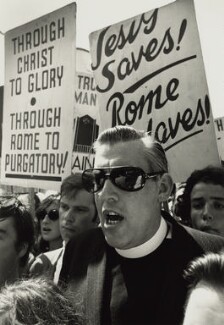
Paisley hated the Unionist establishment. He felt as though their Upper-Class background blinded them to the actual concerns of Northern Irish Protestants, and that their willingness to compromise with the Catholics made them weak. This populist message resonated with most of the Northern Irish who felt that they were not being fairly represented. In 1971, Paisley formed his new political party, the Democratic Unionists. He intended to split and ultimately take over the Unionist platform, but for almost all elections during the troubles, the Ulster Unionists prevailed (Paul & Cowell-Meyers). This did, however, achieve the goal of radicalizing unionists. Although his party often did not win, Paisley was wildly famous, winning more votes than any other Northern Irish candidate towards the end of the Troubles in 1999 (Paul & Cowell-Meyers). Paisley’s rise to fame and more radical stances set Unionists on a train towards deeper troubles, and Ulster Unionists who didn’t conform to the new party themselves were getting plowed over.
Paisley’s fame grew as Protestants hardened as a result of attacks by the IRA. This violence from the Irish insurgents paradoxically was a result of the Unionists damaging them, causing their faction to harden first. Between 1969 and 1971, the Unionist paramilitaries had dropped bombs on both sides of the border, some of which were led by famed counter-insurgent Col. Frank Kittson, who had been in Northern Ireland since September 1970s. Paisley blamed these bombings on Prime Minister O’Neil for not doing enough to secure Northern Ireland (). What was only recently discovered is that Paisley financed some of these paramilitaries, such as the Ulster Voluntary Force (Wallenfedt), making O’Neil the first of many disloyal loyalists to fall prey to Paisley’s rise to power. These attacks led to the largest bombing carried out during The Troubles, also called Bloody Friday, which made the Unionists want harder stances against the IRA (Wallenfedt).
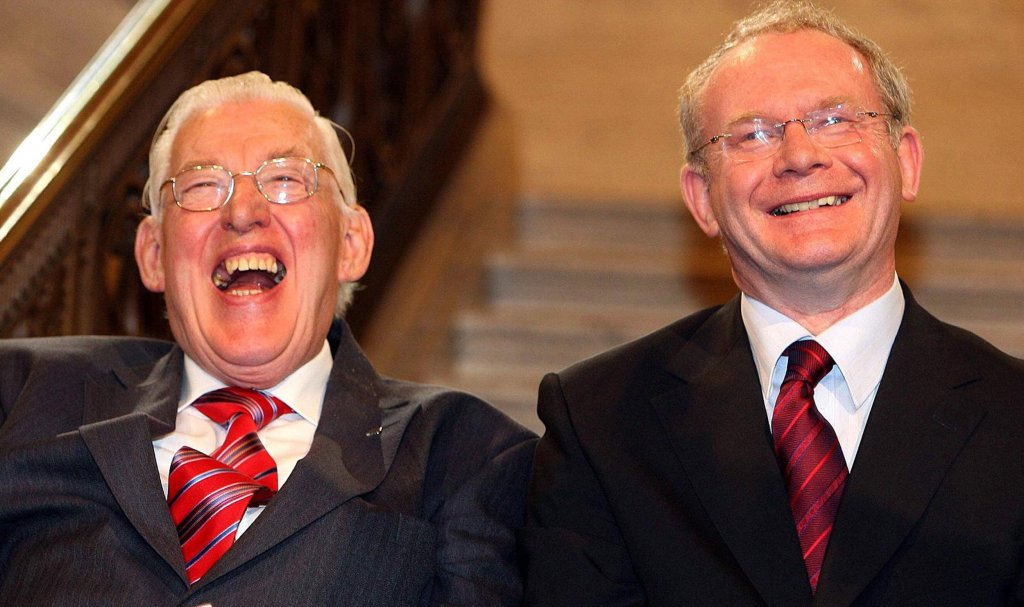
Long after the troubles, Paisley still has a lasting effect on Irish politics. His ambitions were to one day take over as prime minister of Ireland, but unfortunately for him, that day never came. In 2003, the Democratic Unionists finally beat out the Ulster Unionists that would have given Paisley his long-sought power if only the devolved power had not been suspended since 2003 (Paul & Cowell-Meyers). Despite not getting to be prime minister of Northern Ireland, Paisley was a strong influence over the country. Though the peace in Northern and Southern Ireland is fragile, Paisley’s party has worked with Sein Fein after he expressed “Careful Optimism” after they supported a Protestant-dominated police force. In 2007, the DUC and Sein Fein agreed to a power-sharing government after they respectively won the top two seats in the parliament, making Paisley first minister and SF leader, Martin McGuiness, as his deputy. His role as first minister was short lived, resigning after just a year in office (Paul & Cowell-Meyers). Subsequently, Paisley’s relationship with borders and boundaries through the course of The Troubles is readily apparent. Through much of the conflict, he actively hardened boundaries between factions through his actions and rhetoric, and as the peace process got underway, he engaged in certain compromises across these boundaries – thus making them less rigid. Ian Paisley thus stands as another example of how a single individual can have a very complex relationship with borders and boundaries through the evolution of The Troubles.
Works Cited
Arthur, Paul & Cowell-Meyers, Kimberly. “Ian Paisley”. Encyclopedia Britannica. https://www.britannica.com/biography/Ian-Paisley. Accessed December 8, 2020.
Moriarty, Gerry. “Ian Paisley supplied money to UVF for bombings in 1969, documentary claims”. The Irish Times. https://www.irishtimes.com/news/ireland/irish-news/ian-paisley-supplied-money-to-uvf-for-bombings-in-1969-documentary-claims-1.4009254. Accessed December 12, 2020.
Wallenfedt, Jeff. The Formation Of Northern Ireland, Catholic Grievances, And The Leadership Of Terence O’Neill”. “The Trouble”. Encyclopedia Britannica. https://www.britannica.com/event/The-Troubles-Northern-Ireland-history. Accessed December 16, 2020
 A Reader's Guide to Say Nothing