Written by Eileen Reinhardt
Margaret Thatcher was born on October 13, 1925 about 100 miles north of London. Her father, a grocery store owner and local politician, introduced her to campaigning and politics at an early age. She won election to Parliament in 1959, and continued to move up in the Conservative Party’s leadership throughout her years. She became the first woman elected to serve as Prime Minister in 1979, and has since been the longest serving Prime Minister of the 20th century. Thatcher subscribed to the principles of conservatism: economic freedom, individual liberty, personal responsibility, and patriotism. Opinion on her is very divided, explained by Ronald Miller, one of her speech writers: “‘Margaret Thatcher evoked extreme feelings…To some she could do no right, to others no wrong. Indifference was not an option. She could stir almost physical hostility in normally rational people, while she inspired deathless devotion in others” (Gregory 2013). Known as the “Iron Lady,” she came to power during the dirty protest at Long Kesh, and her uncompromising approach to the IRA and Irish Republicanism set the course for the continuation of the struggle.

During Margaret Thatcher’s tenure as Prime Minister, she was a hardliner vehemently opposed to the Republicanism of the IRA and removing British presence in Northern Ireland. She compared the Catholics in Ireland to the people of the Sudetenland in WWII, arguing that “Catholics in Northern Ireland might have been the victims of an accident of geography…that did not give them the right to simply break off and join a neighboring country” (Keefe 204). Using the Sudetenland as an analogy shows that Thatcher did not try to understand the historical discrimination and relationships between Catholics and Protestants in Northern Ireland. Invoking the Sudentenland served as a reminder of Britain’s failure to control Hitler, and Thatcher’s inaccurate comparison and simplification of the issue justified her inflexible stance on the IRA and Republicanism throughout her time as Prime Minister. This inability to learn the causes of Republicanism and the IRA showcases that dangers and destructive actions can happen for both sides when there is a lack of information and understanding by important figureheads.
Thatcher also had another reason to vehemently oppose Republicanism, as her advisor Airey Neave was killed by a car bomb planted by the Irish National Liberation Army right before Thatcher became Prime Minister. This murder “set the stage for her uncompromising posture toward any form of Irish Republicanism” (Keefe 205). The death of her advisor at the hands of other Republicans is an understandable reason to not want to cooperate due to their seemingly violent and destructive nature. This conflict became personal for Thatcher, and it is important to see how that could impact her feelings towards members of the IRA and her subsequent actions later in her career.
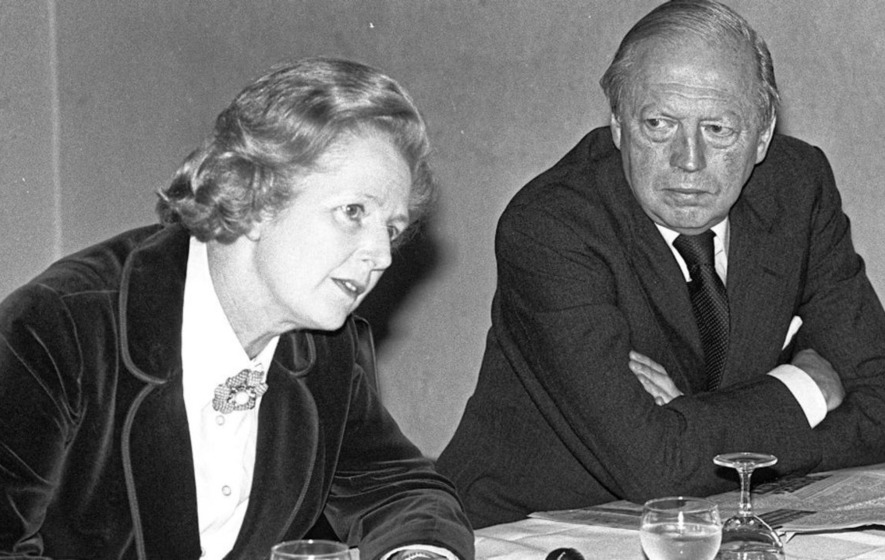
One of Margaret Thatcher’s most famous interactions with the IRA occurred during the Hunger Strikes of 1981. Bobby Sands and nine other men went on hunger strike starting on March 1, 1981, staggering their starts so that if one died the rest could continue. The hunger strikers’ goal was to draw attention to the cause of Irish independence and to be recognized as political prisoners. Thatcher did not show any sign of willingness to compromise, saying: “‘Crime is crime is crime: it is not political, it is crime, and there can be no question of granting political status. I just hope that anyone who is on hunger strike for his own sake will think fit to come off hunger strike, but that is a matter for him’” (Margaret Thatcher Foundation). Thatcher’s comment about crime showcases the tension and difficulties faced between the IRA and the British government. The British government clearly had more power in this situation as it was an institution that was formally recognized as legitimate. In contrast, the IRA was seen and portrayed as a terrorist group by the British government, meaning the IRA had to fight much harder in order to be seen as a legitimate organization.
Thatcher’s determination to define crime as something unrelated to political action delegitimized the IRA and any other forms of violent protest. When Bobby Sands died, Thatcher commented: “‘Mr. Sands was a convicted criminal. He chose to take his own life. It was a choice his organization did not allow to many of its victims’” (Keefe 218). Thatcher’s characterization of Bobby Sands as a criminal with the autonomy to decide his fate is an interesting concept when thinking about the social and cultural context of Northern Ireland. Through many generations, Nationalists passed down their stories and determination to continue the fight for independence. When this is the world that one grows up in and feels apart of, do they really have a choice in how they view themselves and their ways of protesting? Margaret Thatcher also had the choice on how she defined members of the IRA, and she chose to view them as terrorists with nothing good to say. This oppositional dynamic culminated in an assassination attempt on Thatcher, known as the 1984 Brighton Bombing. This further increased hostilities, and Thatcher never publicly showed any remorse or sense of wavering on her hardliner stance. This is an important reminder of how power dynamics and upbringing operated and interacted throughout the Troubles, and Margaret Thatcher serves as an insight into the higher governmental level of the British viewpoint.
Works Cited
Guardian News. 2013. “Margaret Thatcher: A Life in Pictures.” April 8. https://www.theguardian.com/politics/gallery/2013/apr/08/margaret-thatcher-life-in-pictures
Gregory, Joseph R. 2013. “Margaret Thatcher, ‘Iron Lady’ Who Set Britain on New Course, Dies at 87.” The New York Times. April 8. https://www.nytimes.com/2013/04/09/world/europe/former-prime-minister-margaret-thatcher-of-britain-has-died.html
Keefe, Patrick Radden. 2019. Say Nothing: A True Story of Murder and Memory in Northern Ireland. New York: Anchor Books.
Margaret Thatcher Foundation. “Press Conference ending visit to Saudi Arabia (IRA hunger strikes).” https://www.margaretthatcher.org/document/104501
Morris, Allison. 2019. “Airey Neave Murder was a ‘Propaganda Coup’ for INLA but There was No Collusion Says Historian.” The Irish Times. March 30. https://www.irishnews.com/news/northernirelandnews/2019/03/30/news/airey-neave-murder-was-a-propaganda-coup-for-inla-but-there-was-no-collusion-says-historian-1586685/
 A Reader's Guide to Say Nothing