Written by Kathryn Sirianni
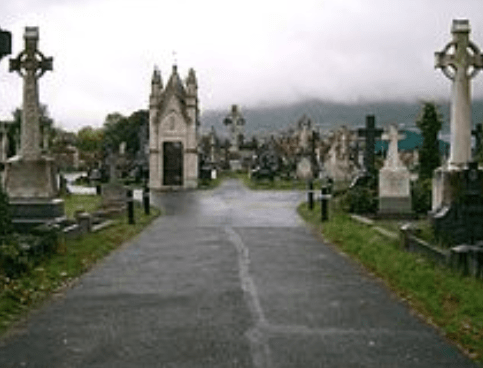
The Belfast Milltown Cemetery was an important historical landmark, described as “one of the largest funeral processions in Ireland, where over 200,000 souls rest”(Ohaire). The Milltown Cemetery has had many tragedies, including the attack in the Spring of 1988, where three mourners were killed and many others injured by British soldiers. Also, the Milltown Cemetery was home to another attack (a few days later) where mourners attacked two British soldiers who took a wrong turn into a Nationalist area. Historically the Milltown Cemetery, “has been the site of many incidents involving paramilitary groups, police and funeral attendees throughout the years” (Ohaire). The Milltown Cemetery was a unique place as during the Troubles it was considered a predominantly Nationalist cemetery with important Nationalist plots and political monuments. However, “here you will find British and Irish soldiers from both World Wars, as well as the mass grave and memorial for the hundreds of victims who died due to Germany’s Belfast Blitz during World War II. Milltown has a history of all sides within its gates, even if it is best known for one” (Ohaire). The Milltown Cemetery is a place where historically, unification between the British and the Irish [Nationalists] has existed. The attack on Milltown Cemetery not only exists on land that represents historical peace (for the British and the Irish), but also sparks the beginning of the peacemaking process in Northern Ireland.
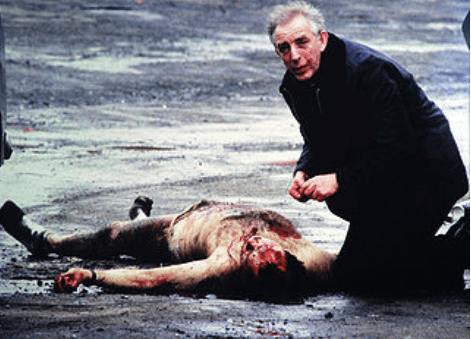
The Milltown Cemetery attack on March 19th 1988, sparked the peacemaking process in Northern Ireland due to Father Alec Reid’s involvement. Father Reid was officiating the funeral when the attack took place, and as the British soldier was dying he decided to read this soldier his Last Rites. Being that Father Reid was a Catholic Priest and the British Soldiers were probably Protestant is important for understanding the complex scenario. Last Rites are, “are a way to bring peace to the approaching death…and are a religious process for cleansing his or her sins before they leave this earth” (Tetrault). By administering the last rights (a Catholic ritual) for a Protestant is a big deal, which can be considered the beginning of the peace process and acceptance. In a documentary Father Reid explains how, “they [Nationalists} threatened me to stand the f*** up or I’ll shoot you” (Reid “Would You Believe- The Secret Peacemaker”). Father Reid’s recollection of the events that happened at the Milltown Cemetery attack and his refusal to pick sides and stop helping the dying soldier shows how he did not see people as Nationalists or Unionists, but rather as just people. Father Reid’s refusal to stop administering the Last Rites to the dying soldiers showcases the beginning of peace in Northern Ireland. The image of Father Reid (depicted on page 236 of Say Nothing) administering the Last Rites to the soldier was powerful in many ways. First the image itself, that displays the body in a Christ-like manner, shows the importance of this killing and the relatability. For people [mainly Catholics] seeing this image it gives them the sorrowful thought of “look what we’ve done” to this man. Relating this to the crucifixion of Christ. This gives them a sense that their violence has been taken too far, and that God wants them to be peaceful. Creating an empathy that can be used for the beginning of the peace process. Father Reid being in the picture also creates a sort of meaning as he is nobly reading the man his Last Rites for no regard of their differences in politics, rather just humanizing the man (by reading him his Last Rites) as he is dying. Father Reid was an influential man, and for people seeing this image models to them how to make peace and to treat people as actual people.
Aside from his actions at the Milltown Cemetery attack, Father Reid was also very involved in the peace-making process of Northern Ireland. The contents of the bloody letter that he was holding during the shooting were the beginning of the IRA ceasefire (Crutchley). This letter would go on to be the beginnings of the peace making process for Ireland, and it can be derived that the attack on Milltown Cemetery fueled Reid’s desire to make peace. Reid was an influential figure in that he, “was deeply unsettled by the violence that had torn his community apart” (Keefe 231). Reid’s peaceful means of delivery of the letter is significant in the IRA ceasefire. The letter was from Gerry Adams (an Irish Nationalist, IRA leader, and Sinn Féin leader) and sent to John Hume (another Irish Nationalist) that began the peace process between the Nationalists and the Unionists. Father Reid’s delivery of the letter shows his devotion to peace and reconciliation. Even after the “bloody letter” that sparked the IRA ceasefire was delivered Father Reid continued to be a model and advocate for peace in Northern Ireland. Father Reid continued to advocate for peace as he, “engaged in many interviews and brought other members of the church along with him to advocate for peace” (Crutchley). Father Reid continued to be a model for peace and reconciliation in Ireland.
The Milltown Cemetery attack was influential in the peacemaking process in Ireland, for its historical influence, the actions of Father Reid during the attack (and after the attack), and the religious and political influence Father Reid had in Ireland. The Milltown Cemetery has a history of peace -where Protestants and Catholics fought, died, and buried together. The idea of the attack that sparked Father Reids momentous contributions to the peacemaking process, happening on land where Unionists and Nationalists were buried (after their fight for a common goal), foreshadows the peace that eventually begins to occur in Northern Ireland. Father Reid’s humanizing actions that he performed during the Milltown Cemetery attack sparked a change in Northern Ireland. Father Reid changed as he began advocating for more peace on both sides and the picture taken of Father Reid administering the Last Rites to the soldier, was used as a religious sign for the beginning of change for the people of Northern Ireland.
Works cited
BBC News. “Gerry Adams: Profile of Sinn Féin Leader.” BBC News, 20 Nov. 2017, http://www.bbc.com/news/uk-northern-ireland-27238602.
Crutchley, By Peter. “IRA Ceasefire 20 Years on: The Priest Who Brokered the Peace.” BBC News, 31 Aug. 2014, www.bbc.com/news/uk-28812366.
Dalby, Douglas. “Alec Reid, Northern Ireland Priest Who Helped Broker Peace Accord, Dies at 82.” The New York Times, 26 Nov. 2013, https://www.nytimes.com/2013/11/26/world/alec-reid-priest-who-helped-broker-peace-accord-in-northern-ireland-dies-at-82.html
Kearney, By Vincent. “‘It’s Over’: Reporting the IRA Ceasefire 20 Years Ago.” BBC News, 27 Aug. 2014, https://www.bbc.com/news/uk-northern-ireland-28957532
Keefe, Patrick Radden. 2019. Say Nothing: A True Story of Murder and Memory in Northern Ireland. New York: Anchor Books.
“Milltown Cemetery, Falls Road, Belfast.” WartimeNI, 27 Apr. 2020, https://wartimeni.com/location/belfast/west/falls-road/milltown-cemetery/.
Ohaire, Shannon. “Milltown Cemetery.” Atlas Obscura, 16 Nov. 2020, https://www.atlasobscura.com/places/milltown-cemetery
Ryder, Chris. “John Hume Obituary.” The Guardian, 12 Aug. 2020, http://www.theguardian.com/politics/2020/aug/03/john-hume-obituary.
Tetrault, Sam. “Guide to Last Rites: Definition, What’s Said & Popular Rites | Cake Blog.” Cake, 19 Nov. 2019, www.joincake.com/blog/last-rites.
“The Belfast Blitz during World War Two.” BBC News, 2016, https://www.bbc.com/news/av/uk-northern-ireland-36040259
 A Reader's Guide to Say Nothing