By Jenny Bartholomay
Seamus Heaney was a Irish poet who lived and worked during the time of the Troubles in Northern Ireland. Although he was not an overtly political figure, many of Heaney’s poems reflect his status as a Catholic living in the north and make subtle commentary or allusions to the conflict between Unionists and Republicans. Keefe references Heaney several times in Say Nothing not only because of his relevance to Irish popular culture, but also as a way to contextualize the discovery of the bodies of “the Disappeared” in Chapter 23, which is titled after Heaney’s poem “Bog Queen.”
“Bog Queen” was inspired by Peter Glob’s research on human bodies preserved in peat bogs in the book The Bog People, and in it Heaney speaks from the perspective of a female body in order to show the connection between life, death, landscape, and femininity in Ireland. In the first stanza, the speaker describes her condition: “I lay waiting/ between turf-face and demesne wall,/ between heathery levels/ and glass-toothed stone” (Heaney, lines 1-4). She continues to describe how natural elements such as the sun, plants, and rock formations have shaped her experience as she continues to “lay waiting,” creating a connection between her body and the landscape that makes the two almost inseparable (Heaney, line 16). Irish nationalism throughout the nineteenth and twentieth centuries often relied on creating a deep association between native Irish people and the Irish landscape, so the Bog Queen’s close relationship with the earth in her death fits in with a common theme of Irish literature.
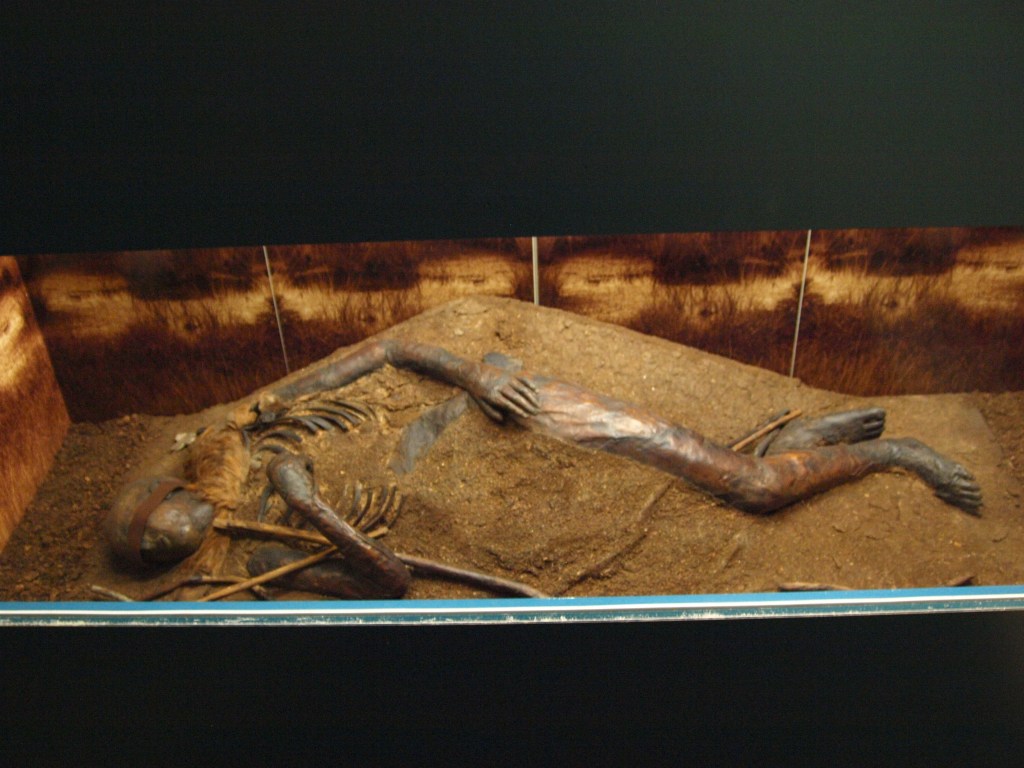
A man working on the land where the speaker is buried eventually discovers her body, making gender a significant theme of the poem in addition to landscape. The speaker describes this discovery as a somewhat violent event, as she claims “I was barbered/ and strupped/ by a turfcutter’s spade” (Heaney). Her connection to the landscape is once again referenced in terms of life and death, as the speaker also recounts that “The plait of my hair/ a slimy birth-cord/ of bog, had been cut/ and I rose from the dark” (Heaney). Stephanie Alexander interprets this discovery, as well as Heaney’s decision to adopt the voice of the Bog Queen for himself, as evidence of “a radical embrace of abject femininity and a patriarchal attempt to bring such wild femaleness under control” (Alexander, 226). While this seems contradictory, the simultaneous celebration and restriction of femininity is yet another common theme in Irish culture that can be seen in works such as “Cathleen Ni Houlihan” and Patrick Pearse’s poem “The Mother.” Taken together, the ideas of life, death, landscape, and femininity in “Bog Queen” support popular Irish tropes and exemplify how a woman ingrained in the landscape “rose from the dark” after a man working the terrain discovered and resurrected her.
In the context of Say Nothing, Keefe references “Bog Queen” as a reminder of how “the past in Ireland is occasionally subject to macabre resurrection” (Keefe, 312). While not all of the attempts of the Independent Commission for the Location of Victim’s Remains were immediately successful, the commission brought the bodies of the disappeared back into the public view in much the same way the discovery of the bog bodies brought the remains of Iron Age Irishmen back into view. Bog bodies became a sort of parallel to the bodies of the disappeared, allowing Heaney’s commentary in “Bog Queen” and perceptions of Irish culture to connect to the context of the Troubles.
References:
Alexander, Stephanie. “Femme Fatale: The Violent Feminine Pastoral of Seamus Heaney’s North.” Canadian Journal of Irish Studies, vol. 39, no. 2, Canadian Association for Irish Studies, 2016, pp. 218–235.
Heaney, Seamus. “Bog Queen.” https://ronnowpoetry.com/contents/heaney/BogQueen.html. Accessed 18 Nov. 2020.
 A Reader's Guide to Say Nothing