By William Mueller
John Kerry’s involvement in attempting to keep the Boston College tapes confidential from the government shows how international politics began to play a role in the Troubles. John Kerry was a Massachusetts senator while Hillary Clinton was the Secretary of the State under the Obama administration. He addressed Secretary Clinton in a letter attempting to have her reconsider her involvement with allowing the British government to have access to the tapes. Senator Kerry feared that the release of the tapes would disturb the peace process in Northern Ireland, and undo some of the work that the Good Friday Peace Agreement achieved. The Good Friday Agreement brought peace and stability to Northern Ireland, and the Clinton administration played a role in bringing peace to Northern Ireland. Senator Kerry mentions the Good Friday Agreement specifically because he knew the Clintons were involved in it. In Senator Kerry’s letter to Secretary Clinton, he writes, “I fully recognize that the United Kingdom has invoked the provisions of our Mutual Legal Assistance Treaty…”(Letter to Sec. Clinton, Kerry). A Mutual Legal Assistance Treaty is where two nations agree to share information with each other in order to enforce the law more effectively. Senator Kerry argues that the government already has a strong relationship with the British government, and not following through with the agreement would not change the relationship between the US and the UK significantly.
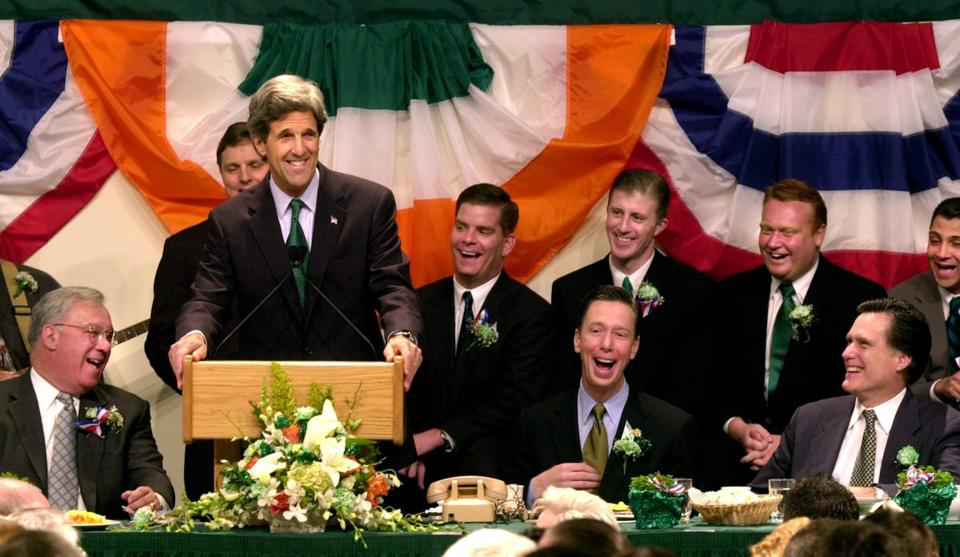
Senator Kerry has always been interested in the peace process in Northern Ireland, and he wanted to continue to build on the impact that the Clinton Administration had with the Good Friday Agreement. Apart from that, Senator Kerry was representing the state of Massachusetts. He wanted to look out for the best interest of Boston College because many people began to question the integrity of the university during this time. When Senator Kerry was running for President in 2004, he attacked President Bush’s public policy with Northern Ireland. Kerry wanted to continue the disarmament of paramilitaries in Ireland, and he also pointed out how President George Bush failed to assign a US Ambassador to Ireland for over a year (AP, 2004). It is clear that Kerry has been passionate and focused on the peace process in Northern Ireland. With legal agreements opposing the confidentiality of the tapes, it was clear that the former IRA members that were interviewed needed support from a politician such as Senator Kerry. After the US District Court Judge William Young ordered the tapes to be seized, John Kerry met with many British politicians and officials to try and persuade them differently. It is interesting to see how invested the US was in the peace process in Northern Ireland, and it is also important to ask why.
The United States are seen as “leaders of the free world” and the US actively works to help countries find peace and freedom. During the 1990s and early 2000s, the US began to seek to end the war on terrorism, especially after the 9/11 attacks. The US and Britain have worked together throughout the years to fight terrorism and replace it with peace, which is why the UK began to negotiate with Ireland for the Good Friday Peace Agreement.
References:
Fitzpatrick, Bryan. “Dramatic Move as Senator John Kerry Steps into Boston College Dispute.” IrishCentral.com, 23 Jan. 2014, http://www.irishcentral.com/news/dramatic-move-as-senator-john-kerry-steps-into-boston-college-dispute-138212494-237428731. Association, Press. “Kerry Condemns Bush’s Approach to Northern Ireland.” The Guardian, Guardian News and Media, 17 Feb. 2004, http://www.theguardian.com/world/2004/feb/17/uselections2004.northernireland.
Kerber, Ross. “Kerry Reaches out on Northern Ireland ‘Troubles’ Records.” Reuters, Thomson Reuters, 27 Jan. 2012, http://www.reuters.com/article/us-usa-britain-ira/kerry-reaches-out-on-northern-ireland-troubles-records-idUSTRE80Q27R20120127.
Keefe, Patrick Radden. Say Nothing: A True Story of Murder and Memory in Northern Ireland. Doubleday, 2019, pp. 223-348.
 A Reader's Guide to Say Nothing