Written by Kathryn Sirianni
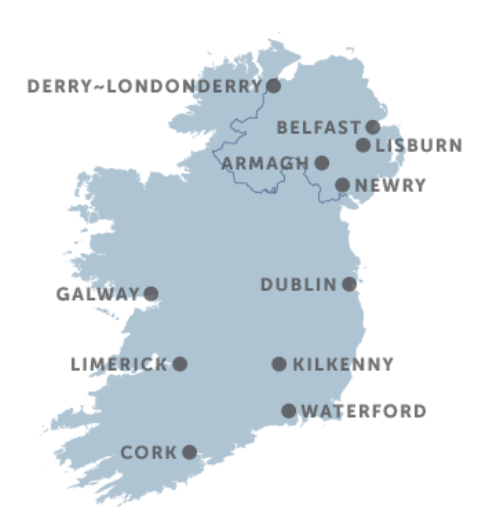
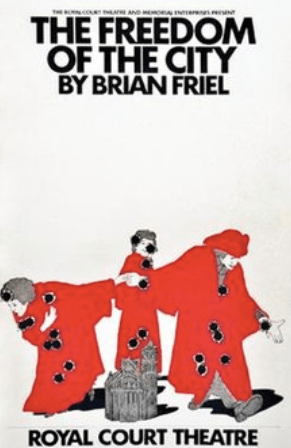
The Freedom of the City was produced in 1973, based on the events of Bloody Sunday written by an Irish man, Brian Friel. Bloody Sunday (Bogside Massacre) was a mass killing of unarmed social rights protestors in Derry (Londonderry) by British soldiers in 1972. The Freedom of the City was a fictional play that demonstrates some of the aspects of Bloody Sunday. The play followed the story of three strangers who were among the protestors in Derry and managed to escape the massacre.
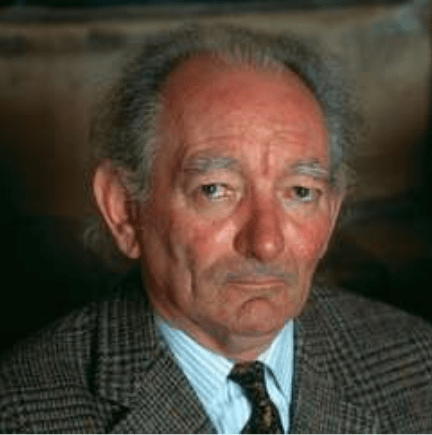
Friel was present during Bloody Sunday in 1972 as he was participating in the march. Friel’s feelings in regards to Bloody Sunday were described in a New York Times article: “Though never active in party politics, he always had nationalist sympathies, which were heightened by memories of what he called “absolutely terrifying” experiences of evading murderous Protestant boys when he was young” (Nightingale). Friel’s experiences in Northern Ireland as a Catholic must have given him inspiration for writing The Freedom of the City, as the characters are a bit representative of Friel as they both survived the massacre. Friel created a play that both amused people, but also used his “voice” as a playwright to speak about injustices in Ireland.
In an interview the modern director of The Freedom of the City, Ciaran O’Reilly states that everyone in the play, “is telling the same story, but from their own perspectives” (“Brian Friel’s The Freedom of the City at The Irish Repertory Theatre”) . Thus showcasing the idea that Friel felt the importance of storytelling and creating new perspectives. His ideas on creating new perspectives was his way of showcasing social injustices that occurred in Northern Ireland, and specifically Bloody Sunday. Although Friel was probably biased when he wrote The Freedom of the City, as he was Catholic and a marcher on Bloody Sunday, his goals for his writings seem to reflect a mediator role as he uses perspectives in his plays to create conversations about the Unionists and Nationalists during the Troubles.
The goals of Friel’s writing was to present the information while also starting [uncomfortable] conversations about the Unionists and the Nationalists in regards to their wrongdoings during the Troubles. Friel believed that the Unionists were wrong for establishing these social injustices, and the Nationalists were wrong for using violence to establish their goal of social rights. Friel was so dedicated to bringing awareness to these injustices that he and Stephen Rae (an actor in The Freedom of the City) created Field Day, which was a company that was, “a culture and intellectual response to the political crisis in Northern Ireland” (Field Day- A Brief History). Friel continued to believe in the idea of storytelling and creating new perspectives that would hopefully create conversations from and about both the Unionists and the Nationalists. The company experimented with the idea of, “if everyone all over Ireland was hearing the same story, on both sides of the border in a divided country, it might have some cohesive effect” (Keefe 225). Field Day was created to form some sort of unification between Nationalists and Unionists. Friel’s addition of both sides to a story was important in understanding how The Freedom of the City functioned towards the audience.
For both the Nationalists and the Unionists watching The Freedom of the City, it was probably a unique experience as it encouraged uncomfortable conversations about their wrongdoings. In Say Nothing, Dolours Price probably resonates with the three main characters in The Freedom of the City as well as with Friel as they both were present during Bloody Sunday. However, it is important to understand that Price did not respond in the way that Friel wanted his audience to. Friel wanted his plays to create a dialogue about the wrongdoings of both the Nationalists and the Unionists. Friel believed that the Nationalists were wrong to enact in violence and the Unionists were wrong for enacting injustices. Price did not understand [or not believe in] Friel’s message when she watched The Freedom of the City, and continued to use violence in the London Bombings. Rather than creating conversations about the Troubles, The Freedom of the City, probably brought back the trauma that Price experienced during Bloody Sunday, only fueling her desire for “revenge” through violence. It is also important to see how both Price and Friel use their power to spread their messages. Price used her power as an IRA member to detonate bombs, which helped spread her message and raise awareness to the social injustices in Northern Ireland. Friel used his talents as a playwright to spread his message to create conversations about the issues with both sides during the Troubles. The Freedom of the City can be used to highlight the different ideas about the issues in Ireland during the Troubles and the different ways that these ideas were spread and examined.
Works Cited
“Brian Friel’s The Freedom of the City at The Irish Repertory Theatre”, Youtube, 2012 https://www.youtube.com/watch?v=syV2_1JQcMk
Crawley, Peter. “Timeline: The Life of Brian Friel.” The Irish Times, 3 Oct. 2015, http://www.irishtimes.com/culture/brian-friel/timeline-the-life-of-brian-friel-1.2376192.
“Field Day-A Breif History.” Field Day, 31 Oct. 2019, http://fieldday.ie/about.
“History.” Royal Court, 25 Apr. 2018, http://royalcourttheatre.com/about/history.
Keefe, Patrick Radden. 2019. Say Nothing: A True Story of Murder and Memory in Northern Ireland. New York: Anchor Books.
Nightingale, Benedict. “Brian Friel, Playwright Called the Irish Chekhov, Dies at 86.” The New York Times, 2 Oct. 2015, www.nytimes.com/2015/10/03/theater/brian-friel-irish-playwright-dies.html%20https://fieldday.ie/abou.
The Editors of Encyclopaedia Britannica. “Bloody Sunday | Summary, Date, & Facts.” Encyclopedia Britannica, www.britannica.com/event/Bloody-Sunday-Northern-Ireland-1972.
The Irish Repertory Theatre. “The.” Irish Repertory Theatre, 12 Aug. 2016, http://irishrep.org.
Tourism Ireland. “Ireland’s Cities.” https://www.ireland.com/en-us/articles/regions/ireland-cities/irelands-cities/
TVGuide.com. “Stephen Rea | TV Guide.” TVGuide.Com, 2016, www.tvguide.com/celebrities/stephen-rea/bio/175361.
 A Reader's Guide to Say Nothing