Written by James McFadden
The Royal Ulster Constabulary was the police force of Northern Ireland from 1922 to 2001 and remains controversial over its tactics, hiring practices, and utterly sectarian partiality to this day. The RUC was the embodiment of institutionalized rule of a majority against the minority for decades and it can be argued that its favoritism towards Protestant Loyalist citizens was a major cause of the development of sectarian violence in The Troubles. Police forces are meant to remain impartial, adhere to the law, and to serve and protect all members of the community, regardless of background or religion. The RUC had difficulty following these basic tenets throughout most of its existence, in many cases doing more harm in terms of polarizing Catholic and Protestant communities than good. The RUC was long associated as being in league with the Unionist government and ideals, as within three years of its establishment the first RUC Orange Lodge was created. The RUC had close ties with Protestant organizations and fought alongside Protestant civilians and paramilitaries several times throughout The Troubles or simply looked the other way at violence towards Catholics. One example of this is the investigation of the 1971 bombing of McGurk’s pub in Belfast “ THE NORTH’S Police Ombudsman Al Hutchinson has found the RUC’s predisposition towards believing the Provisional IRA bombed McGurk’s bar in 1971 became an “investigative bias.” This bias prevented an effective investigation by police of the loyalist bombing that killed 15 people and injured more than 16 but “fell short of actual collusion, the ombudsman said in Belfast yesterday” (irishtimes.com).
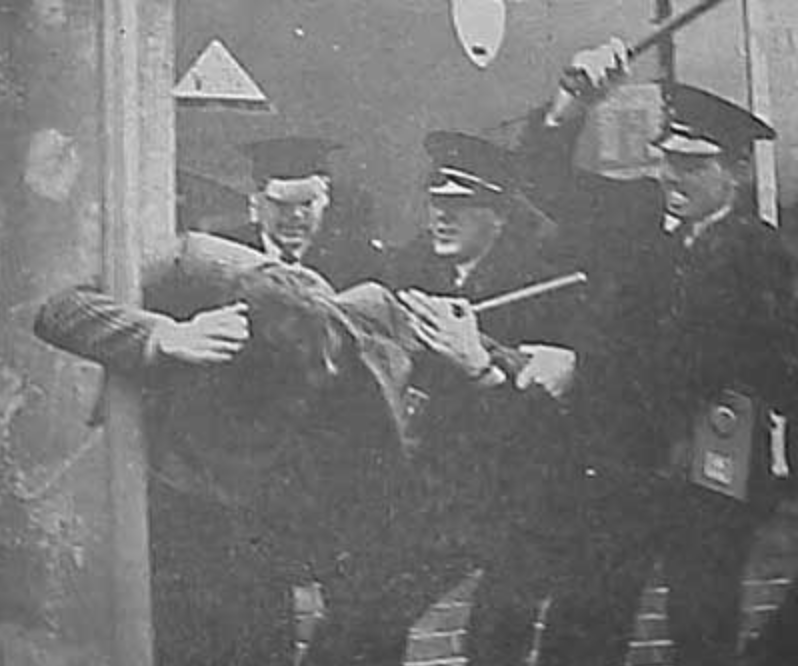
It was widely accepted in the Catholic community that the police were not there to help them and were there to keep them oppressed and maintain Unionist political power and authority. The series of events in 1969 further enforced this idea as time and time again the RUC enflamed the anger of Catholics with their lack of willingness to enforce the law equally. This pattern started in January as the RUC looked on as peaceful protesters were ambushed at Burntollet Bridge, brutally beaten, and not allowed to continue marching forward. If the RUC had protected the march instead of allowing attacks and harassment to persist throughout, perhaps peaceful protest could have stayed the accepted form of resistance and violence would not have become as prominent, or at least not as quickly as it did. The Battle of the Bogside further enraged Catholics at the RUC, as they were blatantly supporting a Protestant parade through Bogside and incited a massive riot as soon as they intervened in clashes between Catholics and Protestant marchers. The fact that Protestant civilians were allowed to fight the Catholic resistance alongside the RUC highlighted how sectarian the police force was. For many Catholics, these actions taken by the RUC to suppress their rights effectively destroyed their confidence in the state. The RUC also created a common enemy for the Catholic community by allying themselves with loyalist movements and agitators, essentially deeming themselves worthy targets for when major incidents of violence were to erupt. Furthermore, this designation of worthy targets represents how the RUC interacted with borders and boundaries, demarcating on sectarian lines who deserved just and equal treatment and who did not – in similar fashion to British conceptual demarcations in response to Bloody Sunday. If they had done anything to restore Catholic faith that they might be protected equally under the law, one can argue that there never would have had to be a military presence and that liberties could have been obtained peacefully. The RUC continued to represent the major inequality in policing and rule of the majority to Catholics for the remainder of The Troubles.
Works Cited
Moriarty, Gerry. “‘Investigative Bias’ Prevented Effective RUC Bomb Inquiry.” 22 Feb. 2011. Web. 02 Dec. 2020.
Melaugh, Dr Martin. Photograph – Derry March (5 October 1968) No.1. 1968, cain.ulster.ac.uk/images/photos/derry5/derry51.htm.
 A Reader's Guide to Say Nothing