Written by Lucas Smith
On July 21st, 1972 more than twenty bombs were detonated in Belfast, killing nine people and injuring one-hundred and thirty, in what would stand as the most voluminous single day bombing attack executed by the Provisional I.R.A. in Northern Ireland. Bloody Friday, as it came to be known, was significant both in the scale of the attack and due to the number of civilians injured or killed. As such, it denotes a crucial issue running throughout The Troubles: the blurring of any clear boundary demarcating a division between civilians and combatants.
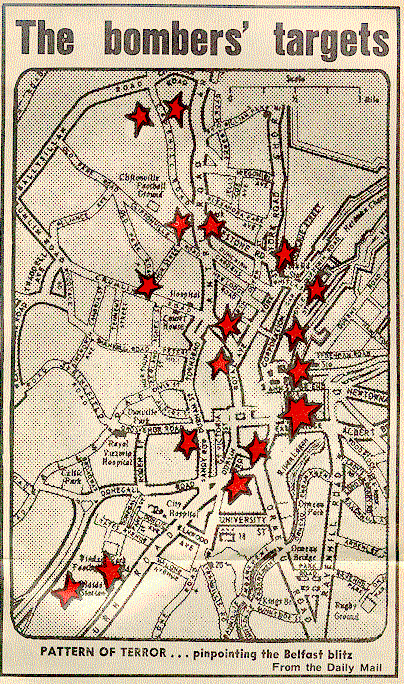
Contemporary map demarcating major detonation sites - https://cain.ulster.ac.uk/events/bfriday/nio/nio72.htm The Troubles did not constitute warfare in its traditional forms. What they did constitute was a breed of armed civil conflict involving various warring factions, both governmental and paramilitary. This type of conflict does not consistently adhere to the expectations of more traditional forms of warfare, and accordingly, the question is raised as to how these factions will interact with the conventional theory of division between civilians and combatants. For the Provos, interaction with this boundary was exceedingly fraught. The complexities of Bloody Friday demonstrate that the organization engaged with the division with paradoxical intent. The Provos endeavored to escalate violence and its impact and they recognized the value of detonating explosives in civilian centers to that end. However, as the reactions of commanders such as Hughes demonstrate, civilian casualties were not, at least conceptually, their goal. Subsequently, their terrorist attacks, especially Bloody Friday, constitute a profound contradiction: the Provos wished to be able to target civilian areas without targeting civilians.

Brendan Hughes has stated he was an organizational commander for the attacks, though he has claimed serious regret for the events of that day. In his Boston College interview, Hughes recalls that as the bombs went off one after another and the fighters he was with began to cheer, he grew angry with them. In recollection, he remarked that as it happened, “I sorta knew there was going to be casualties here” (Segment 4, 3:22). Although Hughes realized as the detonations multiplied the loss of life and limb that was underway, he held that the operation was never designed with an intent to kill, “it was a major major operation, but it was never ever intended to kill people” (Segment 4, 3:35). The Provos did issue warnings shortly before the detonations began, and they long attributed the major part of casualty responsibility to the perceived ineffectual response of the authorities, yet the fact remains that they had planted nearly two dozen explosive devices in crowded civilian centers. One may wonder to what extent the purported lack of murderous intent truly matters when this context is given due consideration, especially when numerous hoax warnings were called in adding to the general chaos – a move that some have speculated was deliberately intended to decrease the efficacy of the authorities’ response (Melaugh, CAIN Web Service). But herein lies the paradox of the Provos’ intent. As terrorists, their primary aim was to engage in violence that would so shock and awe as to bring public opinion in line with their goals. Yet interaction with public perception was always a calculated one, and the Provos had to give thought to the ‘collateral damage’ of life and limb they risked for the civilian public themselves. These devices ranged in payload from roughly thirty to about one-hundred and sixty pounds of explosive material and were placed in bars, railway stations, bus depots, and along busy streets (Melaugh, CAIN Web Service). “I mean if-if I could reverse the situation, I would. I have a firm feeling of regret that Bloody Friday took place,” Hughes acknowledged in his interview, and it seems to be, at least in part, a cognizance of a violation of that boundary between civilian and combatant in those killed and injured that haunted him (Segment 4. 3:55).
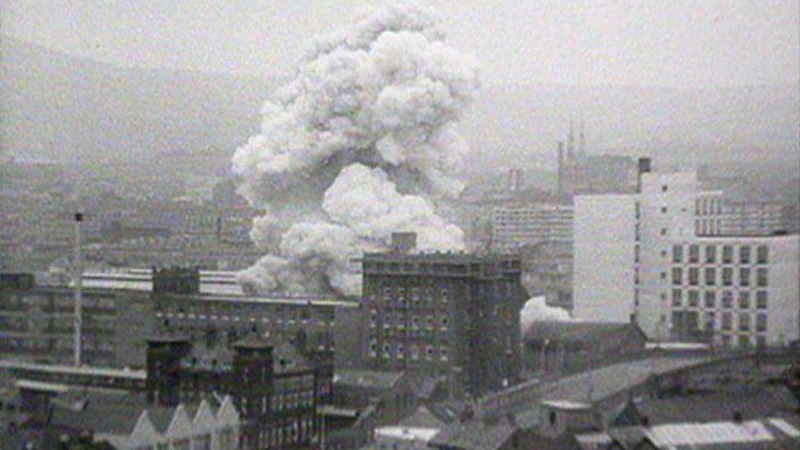
Though Hughes and others may have questioned the morality and wisdom of the attack more immediately following July 21st, it was not until April 16th of 2002 that the Provos issued an official apology for the attack. Even in the text of this apology, the organization maintained the lack of lethal intent, stating, “While it was not our intention to injure or kill non-combatants, the reality is that on this and on a number of other occasions, that was the consequence of our actions” (O’Neill, CAIN Web Service). The distinction of a lack of harmful intent against “non-combatants” is worthy of note, however. The language of this apology coming thirty years later may generally read as sincere, but the clear thought displayed regarding that boundary points to some of its alternate implications. A major part of the type of impassioned civil conflict The Troubles constituted is the battle for ‘hearts and minds.’ Often an awareness of this is shared by both counterinsurgent forces, such as British Army Commander Frank Kitson, and paramilitaries, such as the I.R.A. and U.V.F. And although such devastating events as Bloody Sunday galvanized support for physical force Republicanism and swelled the ranks of the Provos, the missteps of Bloody Friday cost the Provos a great deal of popularity. In such, more Unionists were drawn to organizations like the U.V.F. and the British Army was allowed to implement its crackdown of Operation Motorman, as well as given greater license in undertaking intelligence operations and further pursuing internment.
The conciliatory sentiment of apologies and acknowledgements coming well into the era of the peace process could produce language committed to avoiding, “closing minds and hearts to the plight of those who have been hurt. That includes all the victims of the conflict, combatants and non-combatants” (O’Neill, CAIN Web Service). But such discussion of the boundaries in this noble tone of reconciliation, is to some degree a luxury of peacetime. The same hearts and minds that are now meant to be kept open to the suffering of all, were in the past pragmatically vied for with calculated approaches to violence. When the British Army killed civilians on Bloody Sunday they lost support and their opposition gained it. The outcome was the same for the Provisional I.R.A. when they killed civilians on Bloody Friday. Though some have since expressed moral regret for such occurrences, one is brought to consider to what extent immediate regret could have been more from recognition of a tactical error than humanitarian concern. And when that origin of initial regret is considered, it brings the later reconciliatory regret found in the peace process into question. Were and are such sentiments towards reconciliation genuine or simply considered a diplomatic necessity through the same pragmatism that tried to win allegiance through violence in years past? The answer may not be decisive, yet it certainly troubles the notion of a sudden turn towards sincerity of harmonious sentiment during the peace process. Accordingly, the multi-faceted character of thought surrounding the boundary between civilians and combatants can be seen in its extensive nuance and complexity – and its bloody consequences.
Works Cited
Hughes, Brendan. As quoted in Voices from the Grave. “Voices from the Grave – Documentary.” Boston College Subpoena. Video Segments 1-9. https://bostoncollegesubpoena.wordpress.com/supporting-documents/voices-from-the-grave-documentary/#vog. Accessed November 23, 2020.
McKenna, Fionnuala. Compiled by. “The bombers’ targets.” CAIN Web Service. https://cain.ulster.ac.uk/events/bfriday/nio/nio72.htm. Accessed December 8, 2020.
McKenna, Fionnuala. Compiled by. “DESTRUCTION at Smithfield bus station.” CAIN Web Service. https://cain.ulster.ac.uk/events/bfriday/nio/nio72.htm. Accessed December 8, 2020.
McKenna, Fionnuala. Compiled by. “Glynn Stephen Parker, of Belfast.” CAIN Web Service. https://cain.ulster.ac.uk/events/bfriday/nio/nio72.htm. Accessed December 8, 2020.
Melaugh, Martin. Compiled by. “‘Bloody Friday’, Belfast Friday 21 July 1972 – Main Events.” CAIN Web Service. https://cain.ulster.ac.uk/events/bfriday/events.htm. Accessed November 23, 2020.
“Nine people were killed…” Raidió Teilifís Éireann. July 20, 2012. https://www.rte.ie/news/2012/0720/329866-bloody-friday-anniversary/. Accessed December 9, 2020.
O’Neill, P. As quoted by Martin Melaugh in compiling, “Irish Republican Army (IRA) Statement of Apology, 16 July 2002.” CAIN Web Service. https://cain.ulster.ac.uk/events/peace/docs/ira160702.htm. Accessed November 23, 2020.
 A Reader's Guide to Say Nothing