Written by James McFadden
The Battle of the Bogside is an extremely important event in Irish history and one of the essential events to study when looking at the early years of The Troubles. The rioting and violence that took place from August 12th to the 14th 1969 was the first major outbreak of sectarian fighting where both sides of Catholics and Protestants alike participated. It was also the first event that brought about the deployment of British troops in Northern Ireland during The Troubles.
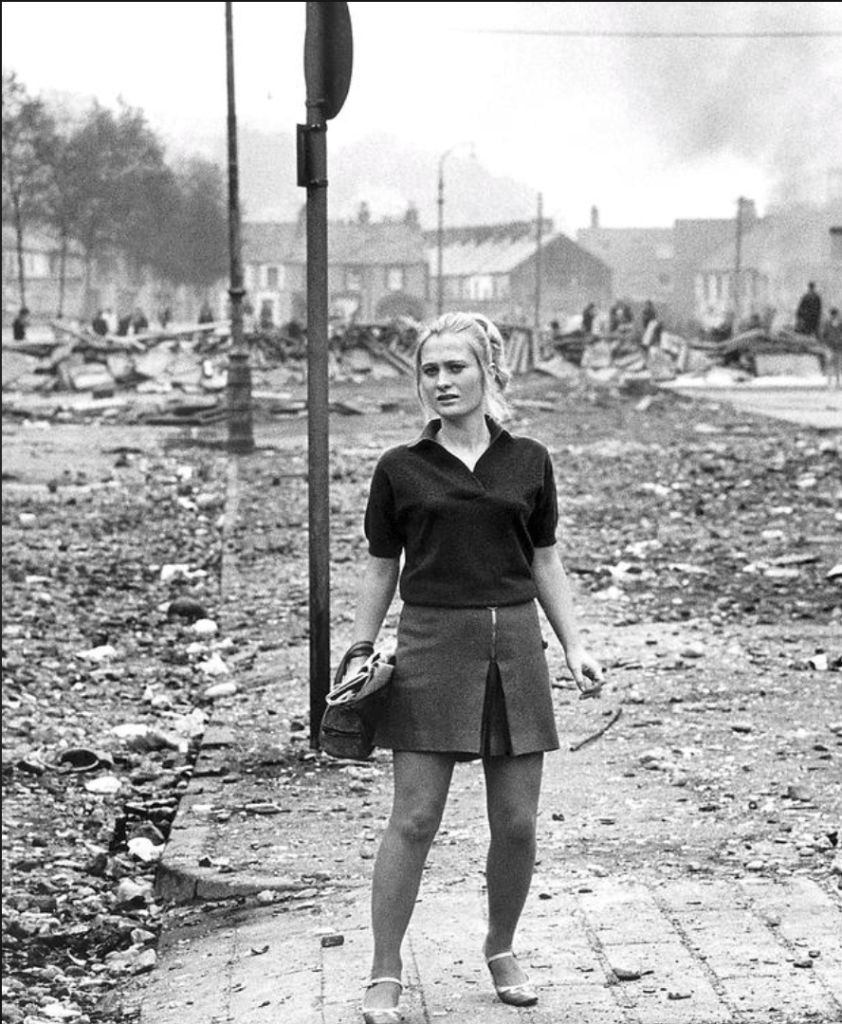
At the time leading up to the fighting, tensions were running extremely high between Catholics and Protestants throughout the North. The year 1969 had been a year of anguish for Catholics, especially with the emergence of the civil rights movement. The civil rights movement had inspired many young Irish people to join its ranks in an attempt to gain their civil liberties through peaceful protest and demonstration, mirroring the civil rights movement of the United States. However, it was made clear in January of 1969 that peaceful marches and protest would not be accepted by Loyalist civilians or the Royal Ulster Constabulary during the People’s Democracy march from Belfast to Derry. During this demonstration, marchers were ambushed by Unionist agitators at Burntollet Bridge while the RUC looked on and did nothing to stop the violence. After this event, many Catholics who were not supporters of the movement became angry with the government and support grew for resistance to the sectarian police state. After the vicious attack at Burntollet Bridge, civil unrest became more and more common throughout the North in 1969, coming to a head in Derry in mid-August. Before looking at the conflict, one must first understand the deep sectarianism that created borders and boundaries both in the literal sense geographically and figuratively through discrimination and disenfranchisement. For centuries, Catholic and Protestant residents of the North lived in largely segregated communities, and Protestants were the only ones who were allowed to govern and police the region. The area of Derry, known as Bogside, was a segregated and tight-knit Catholic area and was quite poor due to the lack of opportunities afforded to Catholics at the time. The Loyalist government had gone so far as to change the borders of different constituencies in Derry so that Catholics could not have any representatives in Parliament. This kind of unfair treatment was bluntly evident in the fact that throughout 1969 the government was open in its support and protection of Loyalist parades passing through predominantly Catholic neighborhoods. However, at the same time, the government openly condemned Catholic demonstrations for civil rights and social justice and consistently had them stopped by the RUC. Frustration at this unfairness boiled over into conflict on August 12th when the Unionist youth group, The Apprentice Boys of Derry, had an annual march planned that was to go through the neighborhood of Bogside. As the apprentice boys marched into the Catholic area, there were immediate scuffles and the situation soon worsened “There were clashes as the Apprentice Boys marched along the wall, past the perimeter of the catholic Bogside area. The RUC intervened and within hours the trouble had escalated into a full-scale riot.” (BBC News, 1969) Soon enough there were stones and petrol bombs being thrown at the RUC and Loyalists and tear gas canisters being launched into crowds of Catholic combatants. Literal borders were erected in the form of make-shift barricades, with the most famous having a sign proclaiming, “You are now entering Free Derry” at the corner of Lecky Road and Fahan Street in Bogside. The fighting went on for two days and was reminiscent of a siege style response by the RUC against the neighborhood of Bogside.
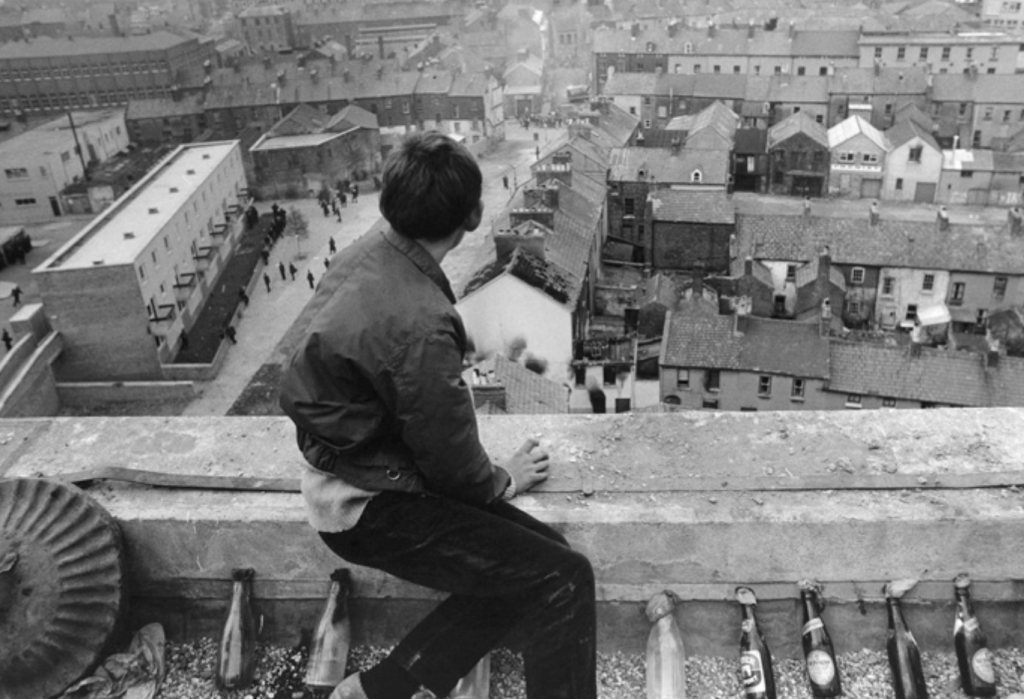
A Young Man with Petrol Bombs primed and ready to throw from the roof of the tower.
The sectarian divide is highlighted by the literal boundaries set up during the battle as well as how hastily and willingly the Catholic community went about organizing and resisting the established authority. The community really rallied behind the outrage and ‘Free Derry’ was established as a stronghold for two long and grueling days. As soon as fighting started, the community established not only the barricades, but also petrol bomb making factories in which mothers and other people who could not or did not want to fight would build the bombs for the rioters in assembly line fashion. There was also a pirate radio station set up for the broadcasting of messages to the Catholic resistance. The RUC could not control the tide of violence and the British deployed troops who landed in Derry on August 14th and the RUC withdrew. The army made no attempt to enter Derry, only to make sure that the violence had subsided. The army, surprisingly, did not rouse the Catholics’ anger but relieved the exhausted combatants on both sides from going further with the violence “The British were warmly welcomed at first. Many Catholics considered British soldiers more neutral and professional than either the RUC or the ‘B-Specials’.” (alphahistory.com) The army was successful in quelling the violence for the time being, but the mental boundaries had already been erected in the community just as physical ones had been. It was at Bogside that lines had been permanently drawn in the minds of Catholics and Protestants as being a part of two different “sides” in a war for rights and freedoms and who deserved them more. It cemented that the troubles were going to be a war of “us versus them” as opposed to a war of the people against the establishment. This permeating feeling of separation created complex justifications for violence on either side which resulted in decades of widespread fear and distrust in Northern Ireland.

Works Cited
“BBC ON THIS DAY | 12 | 1969: Police Use Tear Gas in Bogside.” BBC News, BBC, 12 Aug. 1969, news.bbc.co.uk/onthisday/hi/dates/stories/august/12/newsid_3829000/3829219.stm.
“The Battle of the Bogside.” Northern Ireland, 19 Sept. 2020, alphahistory.com/northernireland/battle-of-the-bogside/.
Deeney, Donna. “Iconic Battle of Bogside Images Go on Display in Derry.” Belfasttelegraph, BelfastTelegraph.co.uk, 16 Oct. 2014, http://www.belfasttelegraph.co.uk/news/northern-ireland/iconic-battle-of-bogside-images-go-on-display-in-derry-30667981.html.
Ricky. “The ‘Free Derry’ Sign and the Battle of the Bogside Mural in Derry, Northern Ireland.” Flickr, Yahoo!, 3 Aug. 2011, http://www.flickr.com/photos/hazboy/6005611024.
“Sinn Fein The IRA and the Sands of Time Part Two.” The North Belfast Journal A View from Napoleons Nose by Fra Hughes, 3 Jan. 2014, northbelfastjournal.wordpress.com/2014/01/03/sinn-fein-the-ira-and-the-sands-of-time-part-two/.
 A Reader's Guide to Say Nothing